
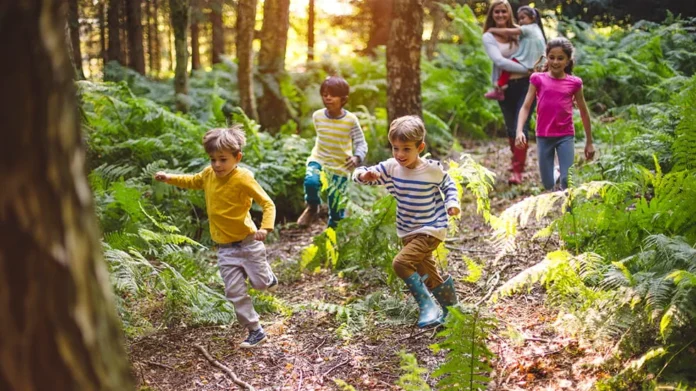
Studies suggest that today’s kids get an average of 4–7 minutes of unstructured time outside a day, while they spend 7–8 hours a day in front of screens.
With a youth mental health crisis also sweeping the nation (rates of anxiety, depression, suicidal ideation, and diagnosed mental health disorders like ADHD are all at record highs), it’s not hard to imagine that the correlation between kids’ indoor confinement and their mental health struggles is more than a coincidence.
The mental health ramifications of too much screen time are easy to track, and are heavily studied. But the downstream effects of not enough time outside are equally startling. Free play and unstructured time are foundational to a child’s well-being, and in America, our kids aren’t getting it.
Seven minutes a day is barely enough time to begin to imagine the premise of a game or an imaginary adventure. Seven minutes a day is barely the amount of time it takes to walk back and forth from the bus stop. It’s not even long enough to go for a walk around the block.
Why Aren’t the Kids Outside?
The twenty-first century has provided us with a perfect storm of conditions keeping kids away from the outdoors: screens are alluring, the outside is “dangerous,” and parents encourage their kids towards sedentary “for your own good” activities (math olympiad! French tutoring! after school clubs!).
Parents fear the dangers of the outdoors. In the modern world, everything from crime statistics to urban design itself lead parents to keep their kids on a short leash. Urban settings don’t have much room for free play; parks and playgrounds and other child-centric outdoor spaces are strangely sparse, as if urban designers wanted a world without kids in it. More apartment complexes are built with dog-washing stations than playgrounds.
The modern world seems to have been built by people who forgot what childhood is, and fears of crime keep parents nervous about letting their kids freely use the spaces that do exist.
But separate from kid-centric space or the lack thereof, kids are busy. Their days are consumed by ever-expanding school requirements, structured extracurricular activities, and of course the ever-present lure of screen time—to the point that even in suburban neighborhoods with big backyards, kids are barely ever venturing outside.
Which is how we end up with kids getting seven to eight hours of screen time a day, but only four to seven minutes of unstructured free time outside—the latter of which people of our grandparents’ generations couldn’t have even imagined.
The “unstructured” part is important—“time outside” in a blanket sense isn’t enough. Spending an hour on the field for soccer practice gives kids the benefit of fresh air and sunshine and physical movement, but it isn’t giving them the psychological benefits of free play.
Unstructured means time and space away from the rules and instructions of an adult. It exists fully in the wild and whimsical world of the child: free, unimpeded, child-directed, and often tinged with a heavy dose of imagination. There are no set goals of the kind that exist in PE class or a sports club. It’s pure and unfettered, and it’s a biologically hardwired need for children’s development.


