
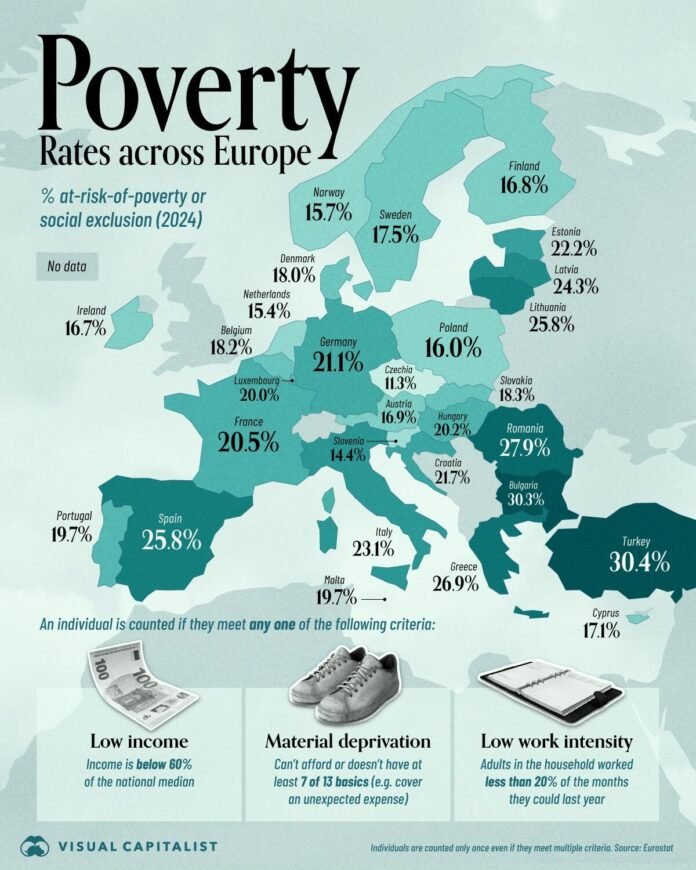
Europe stands as one of the wealthiest regions globally, yet living standards show significant disparities throughout the continent. A recent map from Visual Capitalist, created by Pallavi Rao, highlights the poverty rates in Europe for 2024, based on the percentage of individuals at risk of poverty or social exclusion in each country. The data is sourced from Eurostat.
Unlike the U.S., which measures poverty primarily through income sufficient for food, the European Union considers three related indicators. Individuals are counted if they meet any of the following criteria, though they are only counted once if they qualify for multiple:
- Income below 60% of the national median.
- Material deprivation: lacking seven of 13 essential items, such as the ability to handle unexpected expenses or maintain a warm home.
- Low work intensity: adults aged 18-64 in the household worked 20% or less of the months available last year.
Ranking Europe’s Poverty Rates by Country
Bulgaria (30.3%), Türkiye (30.4%), and Romania (27.9%) lead the rankings, with nearly one in three residents experiencing economic hardship. These elevated rates mirror lower average wages, greater income inequality, and weaker social safety nets compared to core EU nations.
| Rank | Country | ISO Code | % at Risk of Poverty or Social Exclusion |
| 1 | 🇹🇷 Türkiye | TUR | 30.4% |
| 2 | 🇧🇬 Bulgaria | BGR | 30.3% |
| 3 | 🇷🇴 Romania | ROU | 27.9% |
| 4 | 🇬🇷 Greece | GRC | 26.9% |
| 5 | 🇪🇸 Spain | ESP | 25.8% |
| 6 | 🇱🇹 Lithuania | LTU | 25.8% |
| 7 | 🇱🇻 Latvia | LVA | 24.3% |
| 8 | 🇮🇹 Italy | ITA | 23.1% |
| 9 | 🇪🇪 Estonia | EST | 22.2% |
| 10 | 🇭🇷 Croatia | HRV | 21.7% |
| 11 | 🇩🇪 Germany | DEU | 21.1% |
| 12 | 🇫🇷 France | FRA | 20.5% |
| 13 | 🇭🇺 Hungary | HUN | 20.2% |
| 14 | 🇱🇺 Luxembourg | LUX | 20.0% |
| 15 | 🇲🇹 Malta | MLT | 19.7% |
| 16 | 🇵🇹 Portugal | PRT | 19.7% |
| 17 | 🇸🇰 Slovakia | SVK | 18.3% |
| 18 | 🇧🇪 Belgium | BEL | 18.2% |
| 19 | 🇩🇰 Denmark | DNK | 18.0% |
| 20 | 🇸🇪 Sweden | SWE | 17.5% |
| 21 | 🇨🇾 Cyprus | CYP | 17.1% |
| 22 | 🇦🇹 Austria | AUT | 16.9% |
| 23 | 🇫🇮 Finland | FIN | 16.8% |
| 24 | 🇮🇪 Ireland | IRL | 16.7% |
| 25 | 🇵🇱 Poland | POL | 16.0% |
| 26 | 🇳🇴 Norway | NOR | 15.7% |
| 27 | 🇳🇱 Netherlands | NLD | 15.4% |
| 28 | 🇸🇮 Slovenia | SVN | 14.4% |
| 29 | 🇨🇿 Czechia | CZE | 11.3% |
| 🇪🇺 EU | EUR | 21.0% |
Note: Data is unavailable for certain countries not tracked by Eurostat.
Greece (26.9%) and Spain (25.8%) are notable in the south, where unemployment rates rose sharply after the 2008–2014 sovereign debt crisis and have yet to fully recover. Persistent youth unemployment poses challenges for younger generations seeking to build wealth.
Lithuania (25.8%) and Latvia (24.3%) top the Baltic region, revealing a continuing urban-rural divide. Households in rural areas earn approximately 20% less than their urban counterparts, increasing vulnerability to social exclusion.
Northern and Central Europe Show Lowest Poverty Risk
Czechia boasts the lowest poverty rate at 11.3%, followed by Slovenia (14.4%) and the Netherlands (15.4%). These countries benefit from higher median wages and robust welfare programs that mitigate income shocks. Scandinavian nations cluster around the EU average, with Finland (16.8%), Sweden (17.5%), and Denmark (18.0%).
Germany (21.1%) sits just above the EU average (21.0%), reflecting disparities between its industrial southwest and lower-income eastern regions, a lingering effect of reunification.
The EU’s 2030 Poverty-Reduction Target
Brussels aims to lift at least 15 million residents, including 5 million children, out of poverty or social exclusion by 2030. However, progress has stalled since the pandemic, as inflation has decreased real wages and raised energy and food costs. Achieving this goal will depend on improving access to affordable housing, enhancing workforce skills, and addressing gender pay gaps. Without swift income growth in southern and eastern member states, the EU risks deepening the north-south divide.


