
Staff Reporter
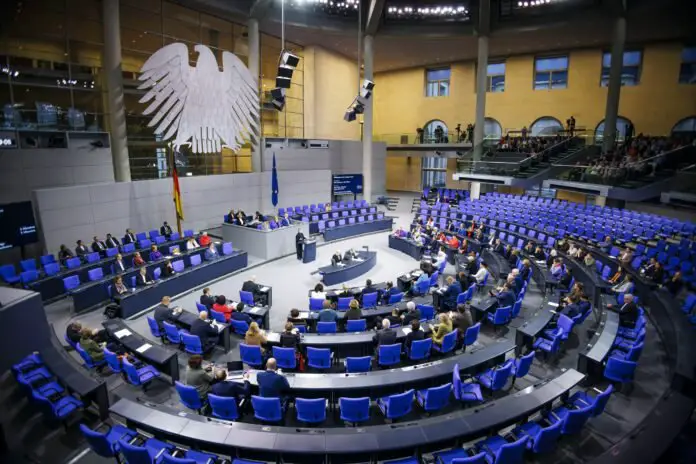
Germany’s Bundestag approved a major fiscal package on Tuesday that amends long-standing debt policies, paving the way for increased defense spending and establishing a €500 billion ($548 billion) infrastructure and climate fund.
The vote saw 513 members in favor, while 207 opposed the plan, with no abstentions. A two-thirds majority was required for the package to pass.
The law now awaits approval from the Bundesrat, the body representing Germany’s states, which is scheduled to vote on it this Friday for it to be included in the country’s constitution.
Under the proposed new laws, defense and certain security expenditures that exceed a specific threshold would be exempt from the debt brake. This rule currently restricts how much debt the government can take on and determines the size of the federal government’s structural budget deficit.
Additionally, loans taken for the infrastructure fund will also be excluded from the debt brake, granting Germany’s states more flexibility regarding their own debt management.
A Boost to the Economy?
Analysts and economists are largely optimistic about the recent reform plans, seeing them as a potential major boost for Germany’s struggling economy.
However, Robin Winkler, chief German economist at Deutsche Bank Research, cautioned that there’s still much to be done by the incoming government.
“This is a historic shift in fiscal policy, arguably the largest since German reunification,” Winkler stated on Tuesday following the vote. “But, similar to reunification, a fiscal expansion doesn’t guarantee success.
The next government will need to implement structural reforms to transform this fiscal package into sustainable growth.”
Germany narrowly avoided a technical recession—defined as two consecutive quarters of economic contraction—throughout 2023 and 2024, but the economy has remained largely stagnant.
On Monday, the OECD revised its growth projection for Germany’s gross domestic product (GDP) to an annual 0.4% for this year, down from a previous estimate of 0.7%. Meanwhile, the German economic institute Ifo has also lowered its outlook, predicting only 0.2% growth year-on-year.


