
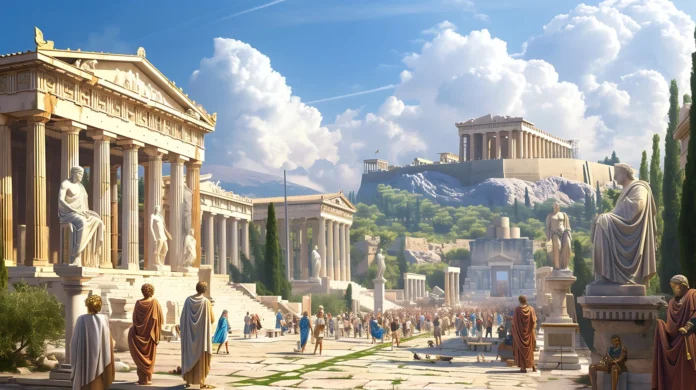
Architecture is significant. It goes beyond mere shelter and utility, embodying the essence of humanity, civilization, and enduring institutions. From the elegant villas of Andrea Palladio in Renaissance Italy to the monumental structures of Washington, D.C., architecture mirrors the values, aspirations, and identity of its people. However, the history of architecture also reveals fractures—times when the bond between our built environment and the human spirit weakens, as exemplified by the stark Brutalism of the 20th century. Revisiting Palladian architecture and its American successors reminds us that buildings are more than just stone and mortar; they are vessels of meaning that can either uplift or diminish the public spirit.
In 16th-century Vicenza, Italy, a young stonecutter named Andrea Palladio evolved into one of history’s most influential architects under the guidance of Gian Giorgio Trissino. A nobleman and Renaissance humanist, Trissino recognized Palladio’s innate talent, introducing him to ancient architectural texts by Vitruvius and the ruins of Rome. This mentorship unlocked a vision that combined practical craftsmanship with classical ideals of beauty.
Palladio’s work is characterized by extraordinary harmony, balance, and symmetry. His buildings—such as the serene Villa Rotonda and the civic Basilica Palladiana—synthesize ancient Roman principles with Renaissance humanism’s focus on order and rationality. More than technical expertise, Palladio’s architecture reflects a commitment to dignifying human life and creating spaces where public and private realms can thrive in nobility and grace.
Vicenza itself became a canvas for Palladio’s ideals. The city’s transformation into a gallery of classical harmony was emblematic of the Renaissance spirit—an awakening to human reason, the beauty of nature, and respect for tradition. Palladio’s architecture was a call to civilization, asserting that human-made environments should inspire virtue, stability, and civic pride.
This architecture spoke a language of its own, communicating through columns, pediments, and proportional geometry. It expressed enduring values, representing a republic founded on reason and law, where individual and community coexist in mutual respect.
Centuries later, across the Atlantic, the young United States looked to these Renaissance ideals to shape its identity. Thomas Jefferson, a dedicated student of classical architecture and Palladio, envisioned a nation whose buildings would embody the dignity and permanence of democratic ideals. Washington, D.C., was designed as a “New Rome,” where monumental architecture would both house governmental functions and proclaim the virtues of liberty, order, and public service. The Capitol’s soaring dome, reminiscent of the Pantheon, and the White House’s classical porticoes stand as testaments to a deliberate cultural continuity, where Palladian principles of symmetry and clarity became the language of statecraft.
This architecture is not cold or distant; it is majestic and inspiring. It invites citizens to participate, trust in institutions, and share in a common destiny. The monumental scale and formal beauty signal that these institutions are meant to endure, serve the public good, and reflect the highest aspirations of civilization.
To grasp why architecture holds such power over civilization and the human spirit, one must consider its philosophical underpinnings. At its highest form, architecture shapes human experience and expresses deeper truths.
The Renaissance, sparked by the rediscovery of classical antiquity, revived the idea that the cosmos itself is ordered by harmony and proportion. Humans, created in the image of a rational universe, reflect this order through art and architecture. Palladio’s work embodies this belief: buildings are microcosms of the universe, carefully crafted to mirror natural laws and human reason.
Both Plato and Vitruvius regarded architecture as a moral discipline. Vitruvius famously argued that good architecture requires “firmitas” (durability), “utilitas” (utility), and “venustas” (beauty). These principles reflect a balance between practical necessity and higher ideals. True beauty inspires reflection on the transcendental; it is the visible expression of truth and goodness. When a building embodies this classical beauty, it elevates the soul, instilling order and peace.
Moreover, architecture serves as a social text, conveying the values of a community. The grand columns and domes of Renaissance palaces or the Capitol building are not merely structural features; they symbolize justice, stability, and collective identity. Thus, architecture becomes a form of “civic education”—teaching citizens about their shared heritage and responsibilities.
The 20th century introduced a rupture in this architectural lineage. In the wake of two world wars and rapid social change, architecture embraced new forms, engaging in social experimentation. Brutalism emerged, marked by raw concrete, stark geometric shapes, and an emphasis on function over ornament. Initially intended to be honest and democratic, Brutalism often conveyed the opposite of Palladian ideals.
Its massive, fortress-like structures felt foreboding and lifeless, alienating citizens from the very institutions they housed. Instead of fostering trust and civic pride, Brutalism symbolized bureaucracy, social fragmentation, and cultural pessimism.
This rupture was more than stylistic; it reflected a broader civilizational crisis—a questioning of long-held values and a modernity unsure of its historical place. The shift from classical beauty to functional rawness represented a deeper separation between society and its ideals, signaling a loss of architectural poetry that nourishes the soul.
Philosophically, Brutalism’s focus on raw materiality and stark function challenges the Platonic view that beauty reflects an eternal order. In this light, architecture becomes merely a “tool of utility,” losing its capacity to inspire awe and elevate the spirit. The result is a built environment that feels oppressive or indifferent to human dignity.
Architecture mirrors who we are and who we aspire to be as a people. The classical ideals embraced by Palladio and the founders of the United States show us that buildings can embody virtue, stability, and grace. They can create spaces where individuals feel part of something larger—of history, community, and purpose.
When architecture honors these ideals, it serves the lasting institutions of civilization: justice, governance, education, and culture. It nurtures the public spirit and strengthens social bonds.
Conversely, when architecture becomes alienating or merely functional, it risks reflecting a fragmented, mistrustful society disconnected from its heritage. The public realm suffers, along with the soul of civilization.
To build for the future is to do so with reverence for the past and hope for the public good. We don’t seek a return to past forms as mindless imitation but a revival of the principles that made them powerful: harmony, proportion, human scale, and civic dignity.
The example of Palladio, shaped by Trissino’s mentorship and Renaissance humanism, reminds us that architecture can be a language of the soul—a discipline expressing our collective commitment to civilization. Washington, D.C., with its neoclassical grandeur, stands as a monumental representation of this ongoing commitment.
In a time that risks forgetting these lessons, it’s vital to remember: architecture matters. It shapes our experiences, influences our spirits, and has the potential to inspire generations to come. Architecture is far more than a historical backdrop; it is a living testament to our values and aspirations. The lineage from Palladio’s Vicenza to the monumental capital of the United States illustrates how the built environment can dignify human life and sustain the institutions that serve the public.
When architecture is conceived with care for proportion, beauty, and public purpose, it nurtures the soul of civilization. When reduced to mechanistic functionality, it reflects and reinforces societal divisions.
As we face new challenges in the 21st century, revisiting these lessons is essential. So, let us reach beyond mere utility and expediency, building for the soul of civilization, creating something that serves the public and inspires the human spirit, while carrying forward the ideals of harmony, dignity, and institutional endurance.


