
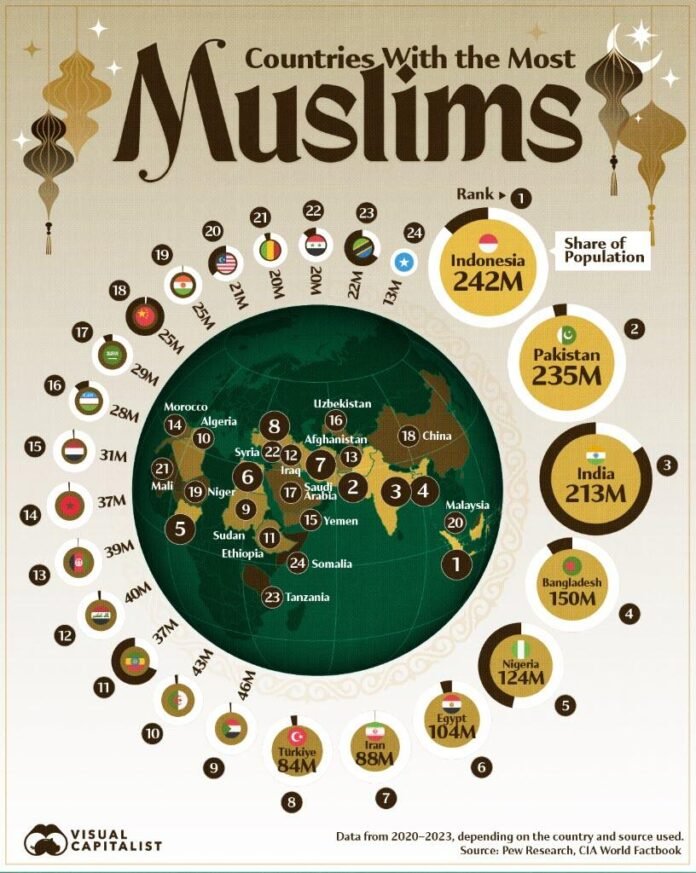
Islam stands as the world’s second-largest religion, with approximately 1.8 billion Muslims spread across every continent. The visualization below, created by Pallavi Rao at Visual Capitalist, ranks countries based on their Muslim populations, highlighting where these communities are most significant.
The data comes from two key sources: Pew Research, which monitors global religious affiliations, and the CIA World Factbook, known for its demographic insights. Due to data limitations, the most recent figures available from 2020 to 2023 have been utilized, depending on each country’s reporting.
Ranked: Countries with the Most Muslims
- Indonesia: 242 million (87.0%)
- Pakistan: 235 million (96.3%)
- India: 213 million (15.3%)
- Bangladesh: 150 million (91.0%)
- Nigeria: 124 million (53.5%)
- Egypt: 104 million (95.0%)
- Iran: 88 million (99.8%)
- Turkey: 84 million (97.0%)
- Sudan: 46 million (99.0%)
- Algeria: 43 million (98.0%)
- Ethiopia: 37 million (31.3%)
- Iraq: 40 million (98.0%)
- Afghanistan: 39 million (99.7%)
- Morocco: 37 million (99.0%)
- Yemen: 31 million (99.1%)
- Uzbekistan: 28 million (88.0%)
- Saudi Arabia: 29 million (92.7%)
- China: 25 million (1.4%)
- Niger: 25 million (99.3%)
- Malaysia: 21 million (63.5%)
- Mali: 20 million (93.9%)
- Syria: 20 million (87.0%)
- Tanzania: 22 million (34.1%)
- Somalia: 13 million (99.8%)
The inclusion of Malaysia and Uzbekistan among the top 20 underscores Asia’s pivotal role in global Muslim demographics.
Muslim-Majority and Muslim-Plurality States in Africa
Africa is witnessing some of the fastest-growing Muslim populations. Nigeria, the continent’s most populous nation, now has over 124 million Muslims, making up more than half its population. In North Africa, Egypt and Algeria report that approximately 95-98% of their residents identify as Muslim, highlighting deep-rooted cultural and religious traditions.
In the Sahel region, countries like Niger and Mali boast near-total Muslim majorities, despite facing challenges from rapid urbanization and climate change that impact migration patterns.
Minorities in Demographic Giants: India and China
In India, the 213 million Muslims represent just 15% of the population, yet this minority exceeds the total population of many countries. In China, Muslims account for only 1.4% of the population, but the figure of 25 million is comparable to Australia’s entire population.
These instances highlight how substantial population sizes can convert even small percentages into millions of adherents. If fertility trends continue, demographers predict that India’s Muslim community could surpass Indonesia’s by mid-century, potentially reshaping global demographics.


