
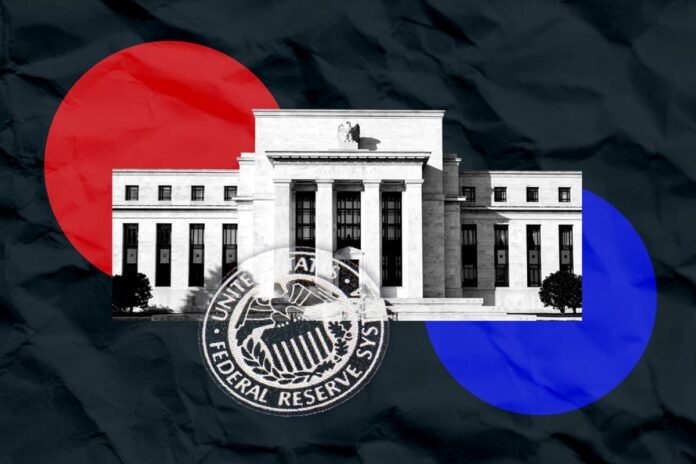
President-elect Donald Trump campaigned vigorously against high inflation, but following his election victory on November 5, financial professionals had shifted their concerns. A new Federal Reserve survey released on Friday indicates that their focus has turned to rising U.S. debt, the potential for a recession, and risks to global trade, which they now see as top threats to the stability of the financial sector.
Concerns about the sustainability of U.S. fiscal debt emerged as the primary risk identified in the survey. The Federal Reserve noted that increased Treasury issuance could potentially crowd out private investment or limit policy responses during an economic downturn. Additionally, worries about a weakening economy and the potential for a global trade war have climbed up the list of concerns.
These concerns are also reflected in the bond market, where yields on 10-year Treasury notes have risen sharply over the past two months, despite the Federal Reserve cutting its benchmark lending rate twice by a total of 75 basis points.
Additionally, measures of interest rate volatility are currently above historical averages, largely due to huge uncertainty regarding the economic outlook and the future direction of monetary policy. There is also an increased sensitivity to news related to output growth, inflation, and the supply of Treasury securities. At the same time, concerns about a potential economic slowdown and the prospect of a global trade war have risen on the list of financial worries.
The survey specifically identified risks to global trade, with some respondents mentioning that tariff barriers could lead to retaliatory protectionist measures, adversely affecting global trade flows and putting renewed upward pressure on inflation. Others noted that a decline in global trade could dampen economic activity and heighten the risk of a downturn.
In a previous survey released in the spring, “persistent inflation” combined with the Federal Reserve’s tight monetary policy was identified as the top risk. However, in the latest poll, it has dropped to sixth place, sharing that position with concerns about global trade.
This survey, part of the Fed’s biannual financial stability report, was conducted among two dozen participants and observers in the financial sector from August to October.
Although this poll was carried out prior to Trump’s election victory, it highlights issues that are likely to be central in forthcoming discussions on taxes, tariffs, and other economic topics.
Some economists suggest that Trump’s anticipated blend of tax cuts and import tariffs could further fuel both inflation and the already substantial federal deficits, particularly as bond markets maintain elevated yields on U.S. Treasury bonds.
The list of short-term risks to stability published on Friday is reminiscent of the financial stability reports from 2019, when “trade frictions” topped the list of concerns after Trump launched a trade war with China and compelled Mexico and Canada to renegotiate the North American Free Trade Agreement.
The report concluded that asset values “remained elevated,” which raises concerns, as high pricing could lead to sharper declines if sentiment or conditions change. It highlighted that liquidity is low and commercial property prices are under strain.
Although household borrowing was deemed “modest,” there has been a rise in delinquencies on some types of loans, and businesses have been borrowing heavily.
Banks, many of which are supervised by the Bank of England and closely monitored for their capital adequacy, “remained sound and resilient.”
However, one specific asset class, the “stablecoins” used within the cryptocurrency ecosystem, was highlighted as both expanding and “vulnerable to runs.”


