

Staff Reporter
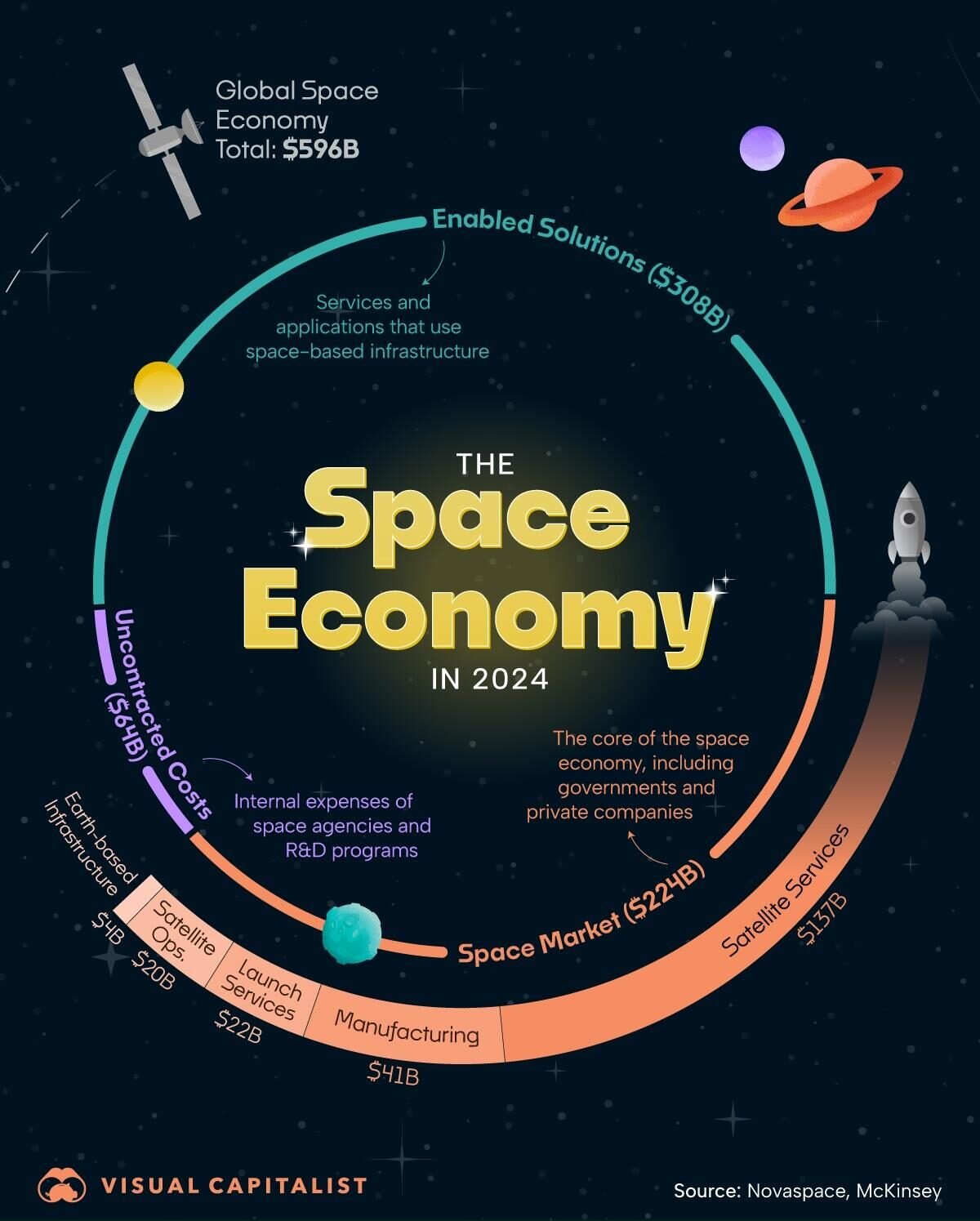
The global space economy hit $596 billion in 2024 and is expected to soar to $944 billion by 2033.
A graphic from Visual Capitalist’s Bruno Venditti illustrates the current scale of the space economy as of December 2024, drawing on data from Novaspace.
This economy encompasses government agencies and companies engaged in producing and launching satellites and spacecraft, generating data, supporting Earth-based infrastructure, conducting research and development, and more.
Over 10,000 Satellites Orbiting Earth
Space-based applications, including weather forecasting, remote sensing, satellite navigation, and satellite television, dominate the market, accounting for a substantial $308 billion.
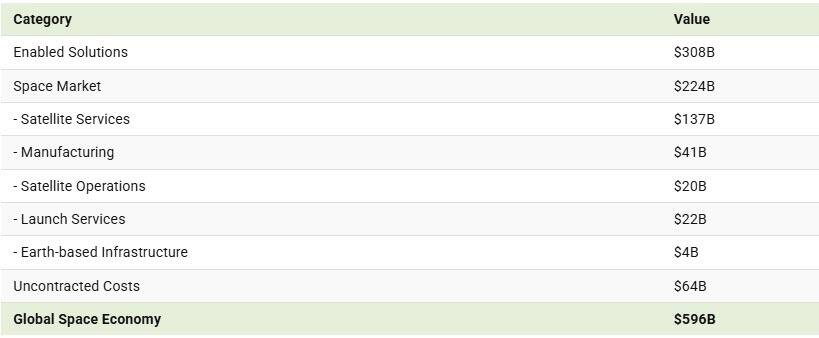
Satellite services are a key driver of the space economy, generating $137 billion annually. Currently, more than 10,000 satellites are orbiting Earth, with SpaceX, led by Elon Musk, holding a dominant share of the market.
Upward Trajectory
In 2024, spaceflight set records for the fourth straight year, with 259 launches worldwide—averaging about one launch attempt every 34 hours, according to a recent analysis of the global space economy. The study, published in The Space Report, forecasts that the launch pace will continue to accelerate this year.
The U.S. led the launch cycle in 2024, outpacing China by more than two to one. Meanwhile, Russia made significant strides, increasing its satellite deployments from 21 in 2023 to 98 in 2024.


