
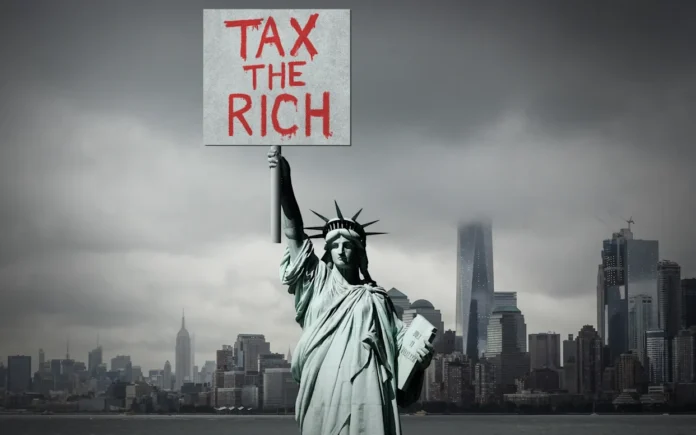
For decades, New York City has billed itself as the world’s financial capital—a crossroads of money, culture and power. But like San Francisco and Chicago before it, it now faces a steady flight of millionaires and ultra-high-net-worth individuals. Some dismiss this as anecdote; the data tell a grimmer story, with stark risks for the city’s finances, social fabric and allure.
It is easy to overlook how much New York’s shiny infrastructure, public services and social programs depend on a tiny slice of residents. Fewer than 1% of taxpayers fund over 40% of the state’s income tax revenue—and a similar share for the city. Without them, millions of ordinary New Yorkers would lose subsidized transit, decent public safety and cultural funding. For all the talk of equality, the masses’ lifestyle quietly rests on the few.
The loss is already visible. Between 2019 and 2020, the number of New Yorkers earning $150,000–$750,000 fell by nearly 6%, while those making over $750,000 dropped by almost 10%, according to the city’s Independent Budget Office. This matters: the top 1% (some 41,000 filers) pay over 40% of all city income tax; the top 10% pay two-thirds. The remaining 90% contribute just a third. Lose even a small share of high earners, and the impact hits hard.
Recent moves confirm the damage. In just a few years, over 125,000 New Yorkers have fled to Florida, taking nearly $14 billion in income with them, per the Citizens Budget Commission. Between 2018 and 2022, more than 41,000—about a third of those movers—settled in Miami-Dade, Palm Beach and Broward Counties. That alone stripped the city of an estimated $10 billion in adjusted gross income. When money can move, political rhetoric can’t stop people voting with their feet.
Into this fragility steps Zohran Mamdani, whose win in the mayoral primary comes with a platform including a new “millionaire’s tax.” His plan would add 2% to New Yorkers earning over $1 million a year, pushing the combined city-state top rate to 16.776%—easily the highest in America. Add federal taxes, and the total burden hits nearly 54%. That is not taxation; it is confiscation.
Wealthy New Yorkers wouldn’t even need to flee to Florida to avoid it. A short move to Westchester, Long Island or New Jersey across the Hudson would do. As the Tax Foundation notes: “A high earner doesn’t need to give up the city’s convenience—just move outside the five boroughs.” Developers are already pushing back against Mamdani’s rent-control plans, while Florida realtors report a surge in inquiries from wealthy New Yorkers.
Instead of recognizing this fragile balance, Albany and City Hall keep treating the wealthy as an endless resource. Every budget cycle brings new tax hikes, justified by cries of “fair share.” But for the city’s most mobile taxpayers, there’s a limit. More and more, they’re deciding enough is enough.
Don’t feel sorry for them, though. Other American states and cities are eager to take them in. Florida has no state income tax and a climate that feels like a bonus. Texas markets itself as business- and family-friendly—where capital is welcomed, not penalized. The Lone Star State is even planning its own stock exchange to counter corporate ESG/DEI rules. Even Connecticut, once mocked as a commuter backwater, now pitches itself as a calmer, lower-tax option a train ride away.
It’s not just states. Cities from Miami to Austin to Nashville are building entire ecosystems—schools, cultural centers, financial clusters—to attract and keep disaffected New Yorkers. Migration data show these efforts are working.
The bitter irony of this exodus—driven by government greed—is that the very policies meant to fix inequality are widening a new gap. On one side are places like New York, with extractive tax regimes, growing ever more dependent on a shrinking pool of wealthy residents. On the other are “merely high-tax” or moderate-tax states that balance revenue needs without driving out their most productive citizens. By trying to punish the “haves” in the name of the “have-nots,” New York is creating a sharper split between where the wealthy live and where they’ve left. The intended redistribution becomes geographic: capital, philanthropy and jobs follow the departing millionaires.
There’s a cultural cost, too. Wealthy New Yorkers aren’t just taxpayers—they’re arts patrons, hospital benefactors and funders of civic groups. When they move to Florida, Texas, Tennessee or Wyoming, they take more than checkbooks: they take their board seats, galas and fundraising networks. New York’s identity as a city of ambition fades. A place that once drew the world’s best risks becoming somewhere they leave once they’ve succeeded.
This migration isn’t an abstract threat—it’s an early warning of what happens when finances are unbalanced and politicians are greedy. New York can keep grabbing headlines with promises to soak the rich, or it can admit that prosperity needs partnership, not punishment. Choose the former, and the flight will speed up. One day, the city might wake up to find its most valuable export isn’t finance or culture—it’s people. Wealth, like love, doesn’t stay where it’s unappreciated.


