

Long before the rise of artificial intelligence, which many fear could render certain jobs obsolete, technology has already transformed the workforce. Some jobs have vanished entirely, while new ones have emerged.
For instance, did you know that people once worked as living alarm clocks before actual alarm clocks were invented? Known as “knocker uppers,” these individuals roamed industrial England, using long sticks to tap on workers’ doors and wake them in time for their shifts.
There were also “computers” long before personal computers hit the scene. These were people who performed mathematical calculations—a service that is no longer needed today.
So, which jobs are next on the chopping block? Each year, the U.S. Bureau of Labor Statistics releases its Occupational Employment Projections, which analyze the labor market for the next decade. This report highlights potential employment changes by occupation and identifies jobs most vulnerable to automation and other technological shifts.
According to Statista’s Felix Richter, the latest report covering the 2024-2034 period identifies four occupational groups expected to see job losses: office and administrative support, production, sales and related roles, as well as farming, fishing, and forestry.
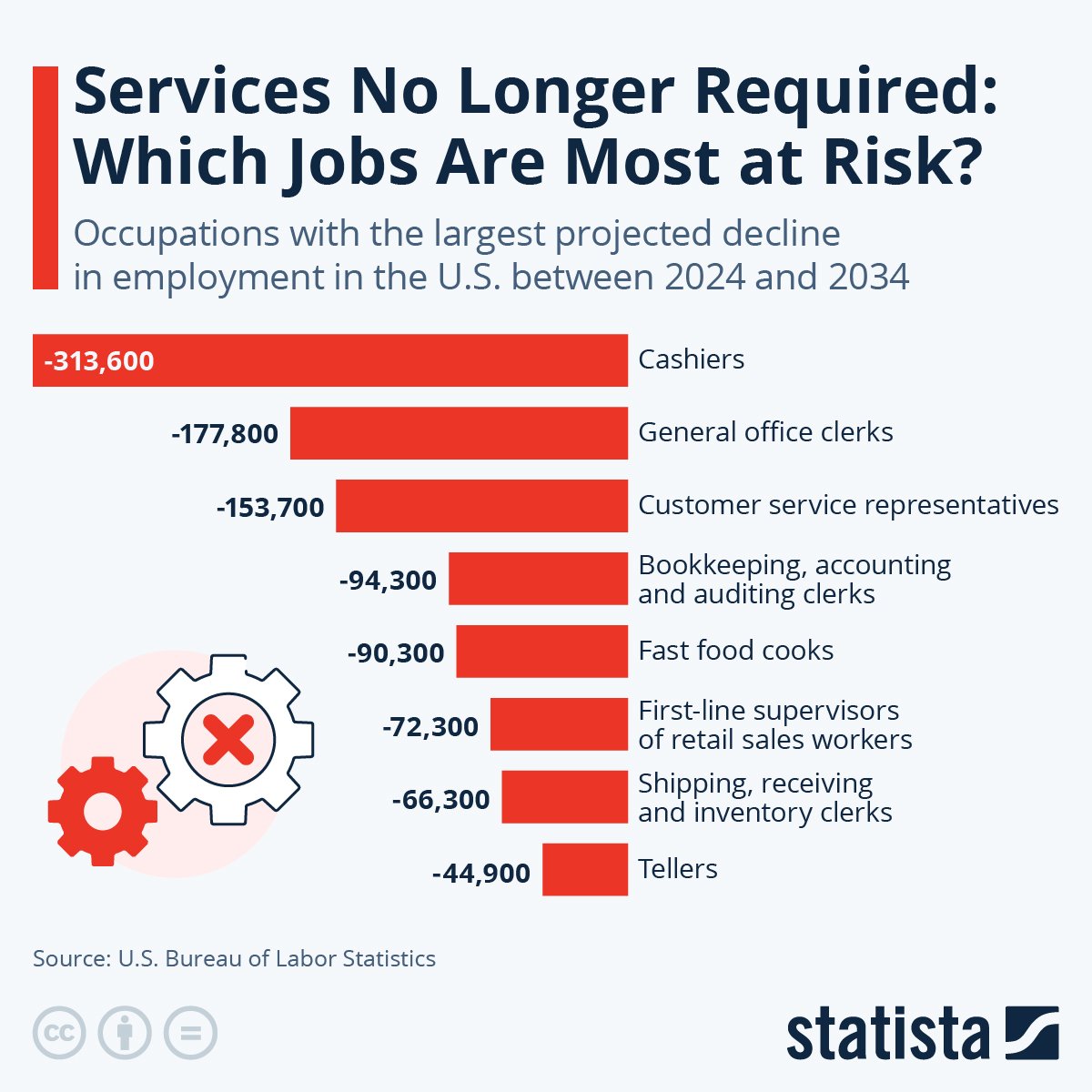
The data shows that cashiers, facing competition from self-checkout machines, are projected to experience the largest decline, with a loss of 313,600 jobs by 2034 compared to 2024.
Other at-risk positions include office clerks and customer service representatives, particularly as AI chatbots become more prevalent in customer service roles.
When examining relative employment changes, word processors and typists (-36 percent), roof bolters (-34 percent), and telephone operators (-27 percent) are among the fastest disappearing jobs. However, these positions are relatively rare, so their absolute numbers don’t significantly impact the overall job market.


